

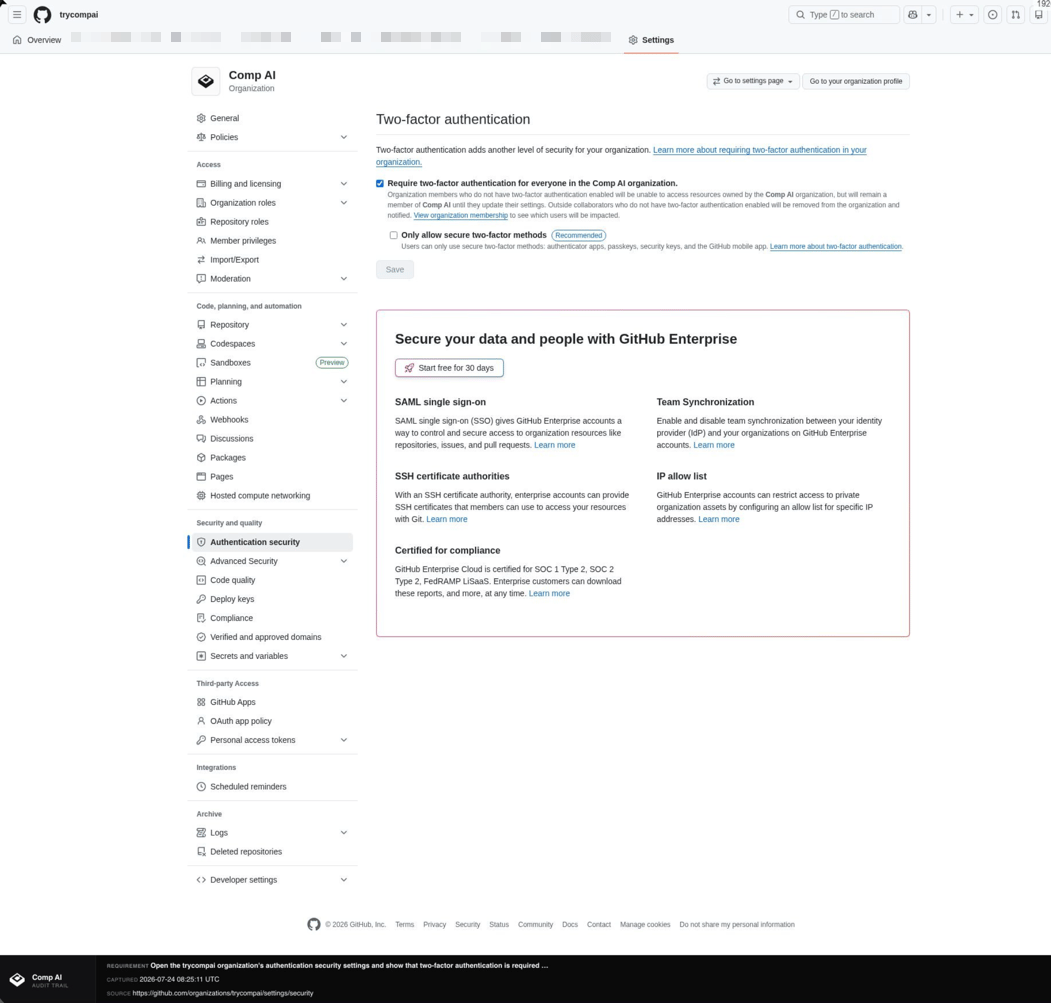
Every run produces an audit-ready screenshot, stamped with the requirement, source, and timestamp.
Why it’s powerful
- It reaches evidence nothing else can. Plenty of tools have no API or integration — Browser Automations sign in and screenshot the page directly, so you can prove a control that would otherwise be a manual screenshot.
- It handles 2FA on its own. Give it the authenticator setup key once and it generates the codes itself, so scheduled runs never wait on your phone.
- It stays fresh without you. When a session expires, it re-signs in on its own — evidence keeps updating on schedule instead of going stale between audits.
- It’s auditor-ready by default. Every capture is stamped with the requirement, source, and timestamp, and can carry a pass/fail verdict.
What you can do
- Collect evidence from web apps that have no API or integration.
- Sign in on a schedule, including 2FA — Comp AI generates the one-time code for you.
- Watch a run live and take over in the browser if a step needs a human.
- Get an audit-ready screenshot stamped with the source and timestamp, plus an optional pass/fail check.
- Manage every vendor login in one place under Settings → Browser connections.
How it works
There are three parts:- Connections — the vendor logins Comp AI signs in with (Settings → Browser connections).
- Browser evidence — the automations that use those logins, created inside an evidence task.
- Schedule — Comp AI signs in, captures the page, and re-signs in on its own when a session expires.
Prerequisites
Before you start, make sure:- Your organization has the feature enabled.
- You have access to Settings and to the evidence task.
- You have the vendor login you want Comp AI to use — ideally a dedicated service account rather than a personal one.
Connect a vendor
You can connect from a task’s Browser evidence section, or from Settings → Browser connections → Connect a vendor.- Enter the vendor’s sign-in URL.
- Comp AI reads the sign-in page and shows the exact fields it asks for — it detects whether the login uses an email, a username, or extra fields like a workspace.
- Choose how Comp AI signs in: with a stored login, or via single sign-on (SSO), where you finish at your identity provider.
- Enter the login. Comp AI signs in for you in a live browser. If a step needs you — a 2FA prompt, an email code — you can take over in the same browser and hand it back.
Unattended 2FA
This is what makes scheduled runs truly hands-off. If your login uses an authenticator app, give Comp AI the setup key once, and it generates the rotating 6-digit codes itself — so scheduled runs never wait on your phone.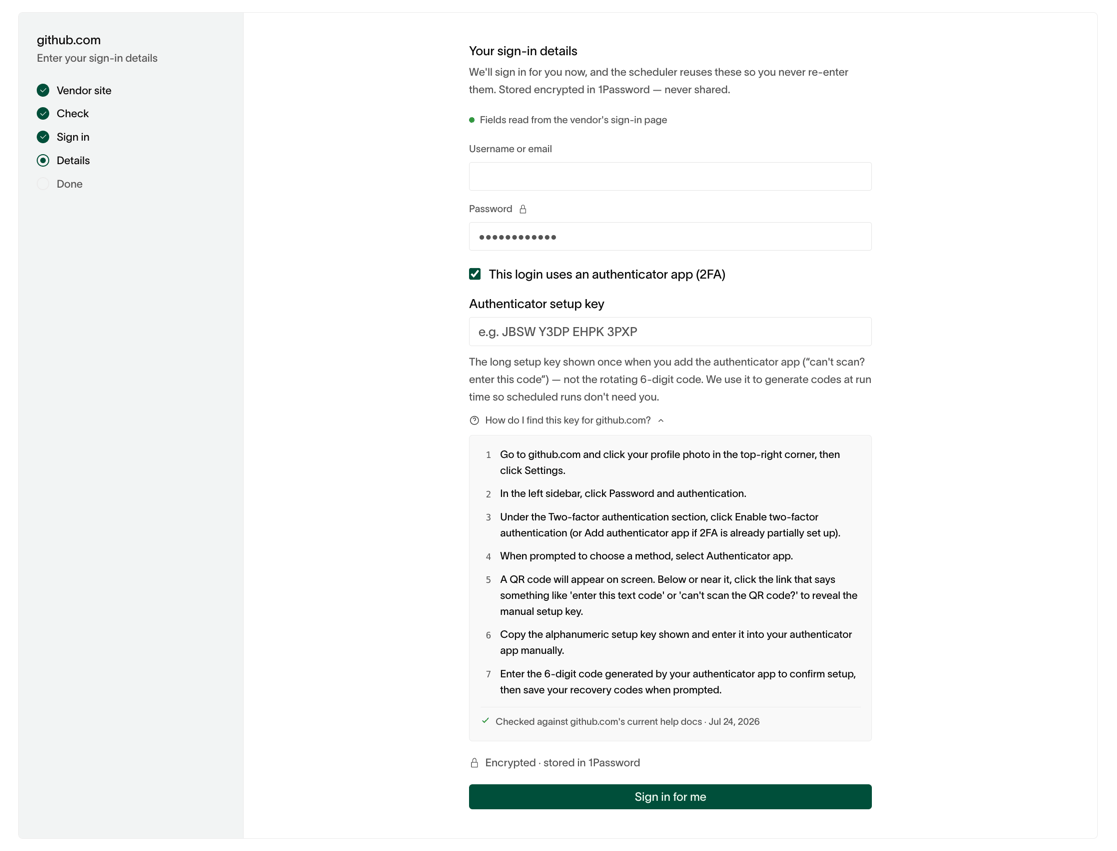
The setup-key field, with per-vendor steps — 'How do I find this key?' — generated from the vendor's current help docs.
- Enter the setup key, not the code. The setup key is the long, one-time key shown when you add an authenticator app (the “can’t scan? enter this code” option) — not the rotating 6-digit code your app displays.
- Not sure where to find it? Select “How do I find this key?” next to the field. Comp AI shows the steps for your specific vendor, checked against its current help docs.
- You can also turn this on later — open the connection under Settings → Browser connections and add the authenticator key without re-entering your password.
Create a browser evidence automation
Inside an evidence task, open the Browser evidence section:- Describe what to capture in plain English — for example, “Open the organization’s security settings and show that two-factor authentication is required for all members.”
- (Optional) Add a pass/fail check — for example, “Two-factor authentication is required for everyone.” Without one, the run captures a screenshot only.
- Test it. Watch the automation run live, then review the screenshot and result before you commit.
- Save. It now runs automatically on the task’s schedule — Daily, Weekly, Monthly, Quarterly, or Yearly, your choice — and keeps the evidence current. You can also run it on demand any time.
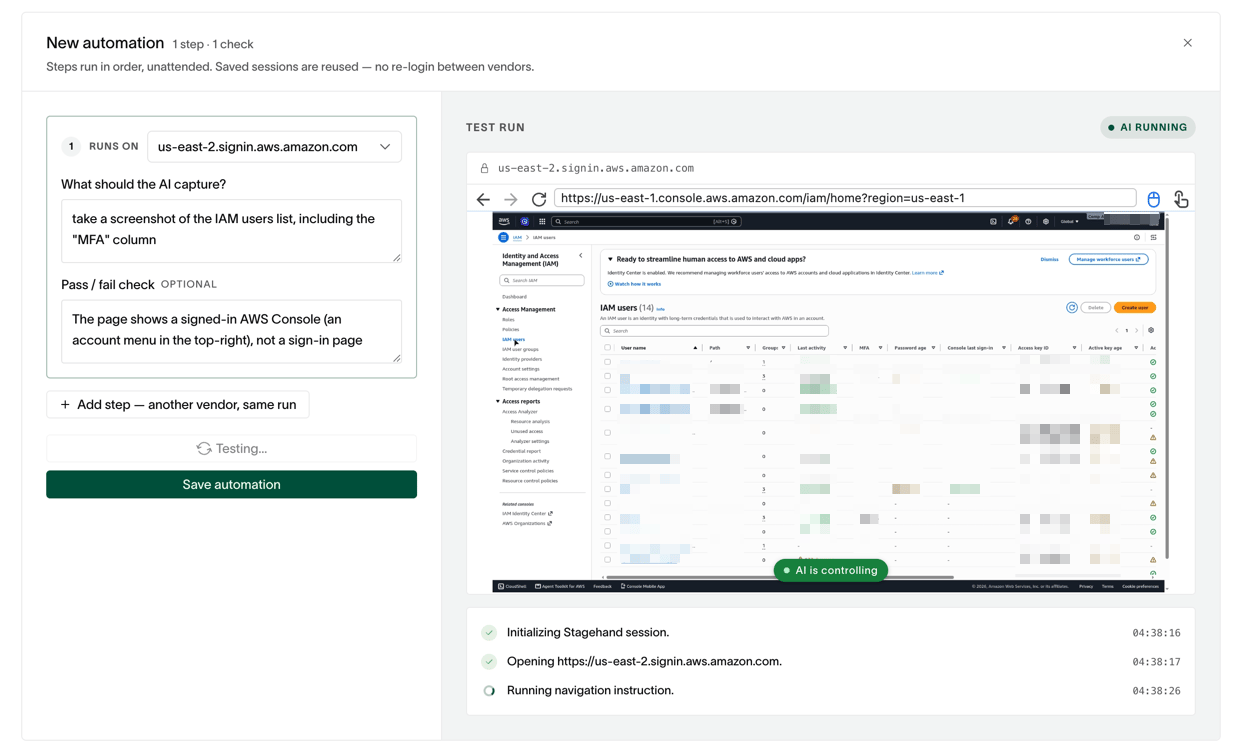
Testing an instruction — watch the AI drive a real browser live, then review the screenshot and verdict before saving.
Schedule and manual runs
Once saved, an automation runs automatically on a schedule — you don’t have to trigger it. You choose how often: set the cadence to Daily, Weekly, Monthly, Quarterly, or Yearly from the schedule control in the Browser evidence header. One cadence applies to all the browser evidence on that task, so a task’s proof refreshes together. You can change it any time. Need proof right now? Run any automation on demand — its screenshot and verdict appear in the row as soon as it finishes, without waiting for the next scheduled run. On each run — scheduled or manual:- Comp AI signs in, navigates to the page you described, and captures a screenshot stamped with the requirement, source URL, and capture time. If you added a check, it records a pass or fail with a short reason.
- If the saved session has expired, Comp AI re-signs in on its own — using the stored login and a freshly generated 2FA code. You don’t have to do anything.
- If it hits something only a person can clear — a captcha, a “verify it’s you” prompt, or an SSO/passkey step — the run pauses and the connection is flagged Needs reconnect, with a one-click Reconnect.
Manage your connections
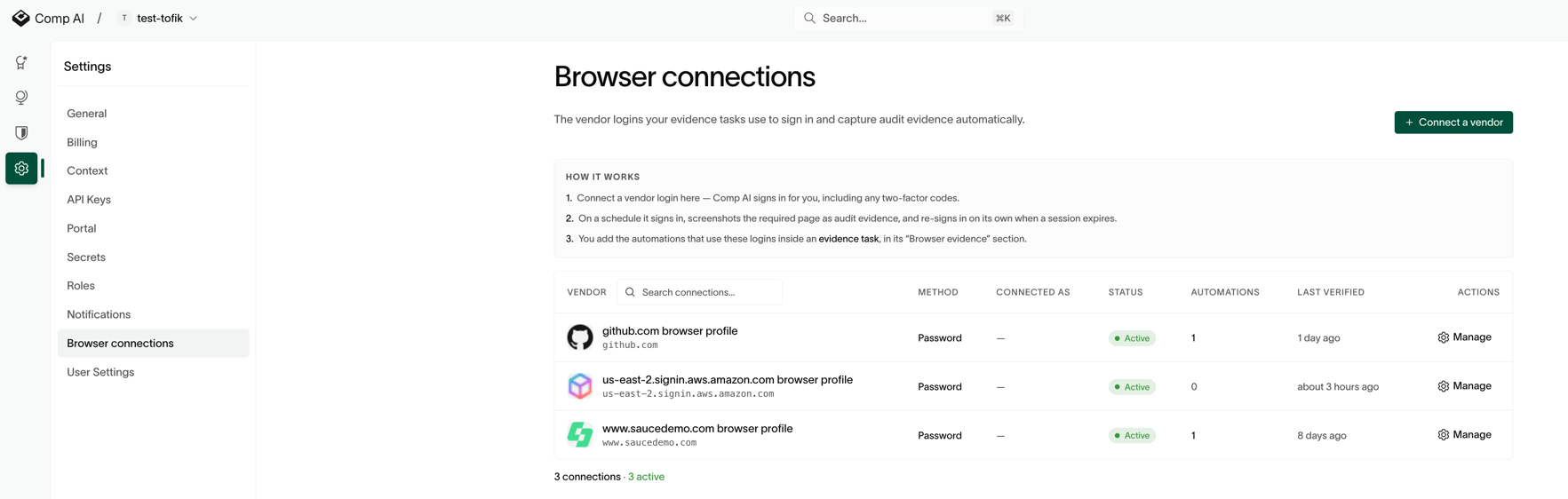
Every vendor login in one place — with health status, search, and per-connection actions.
- See every connection with its status: Active, Needs reconnect, or Blocked.
- Search and page through them when you have many.
- Reconnect, rename, or change the login.
- Turn Automatic 2FA on or off, or replace the authenticator key.
- Remove a connection you no longer need.
Best practices
- Use a dedicated service account and a dedicated MFA device for each automation.
- Point each automation at the specific page or setting so the screenshot shows just that, not a long list.
- Prefer a direct sign-in or settings URL — runs are faster and steadier when they start close to the target.
- Keep automations meaningful: pair each with a pass/fail check where the requirement is clear.
Troubleshooting
A connection says “Needs reconnect”
The saved session expired or a login step needs a human
A connection says “Needs reconnect”
The saved session expired or a login step needs a human
The steps for finding my authenticator key look generic
Vendor-specific vs. general guidance
The steps for finding my authenticator key look generic
Vendor-specific vs. general guidance
The run paused for a captcha or “verify it's you”
Challenges that require a person
The run paused for a captcha or “verify it's you”
Challenges that require a person
I don't see Browser connections in Settings
Feature access and visibility
I don't see Browser connections in Settings
Feature access and visibility
Support
If you need help with Browser Automations:- Contact support at support@trycomp.ai
- Join our Discord community